

Most Australians who invest in property think about houses and apartments. Commercial property barely registers as an option, partly because it sounds complex and partly because the entry points seem out of reach.
Both assumptions are worth challenging. Commercial real estate in Australia is a $36 billion market growing at nearly 9 per cent annually, and individual investors are increasingly finding ways in. But it works differently from residential, and understanding those differences is the starting point for any serious consideration.
Understanding the differences before you invest is not optional. They are significant.
Leases are longer and more complex. Commercial leases typically run three to ten years, sometimes longer. That provides income certainty that residential landlords don't have. But it also means choosing the right tenant matters enormously. A bad tenant on a five-year lease is a very different problem from a bad tenant on a twelve-month residential lease.
Tenants typically pay outgoings. In many commercial leases, tenants pay council rates, water, and building insurance rather than the landlord. That changes the net return calculation significantly compared to residential, where landlords absorb most outgoings.
Vacancy is more concentrated and more expensive. When a commercial property sits vacant, finding a new tenant takes longer than in residential. Vacancy periods of six to twelve months are not unusual in some commercial sectors. Building that risk into your financial modelling before you buy is essential.
Lending works differently. Banks typically require larger deposits for commercial property -- 30 to 40 per cent compared to 10 to 20 per cent for residential. Loan terms are shorter. And the assessment criteria focus more heavily on the income-producing capacity of the asset rather than the borrower's personal income alone.
Yields are generally higher. The trade-off for the additional complexity and risk is better yield. Well-chosen commercial properties in good locations can deliver gross yields of 5 to 8 per cent, compared to 3 to 4 per cent in many residential markets.
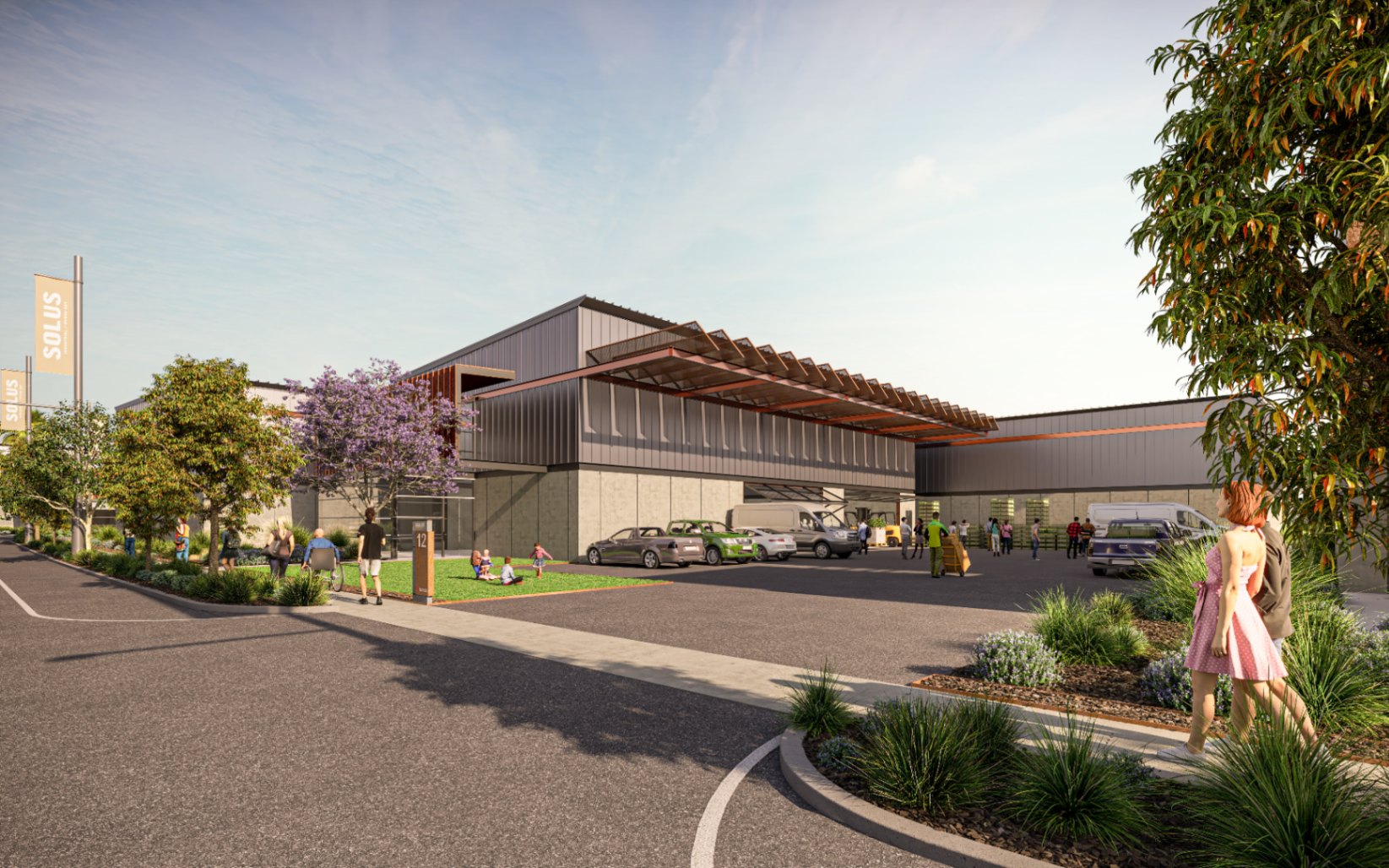 Coposit | Buy with $20K | Off the plan Industrial | Invest in Storage Units in NSW
Solus Industrial | Off the plan industrial | Secure with $20k and $24,063 x 13 weeks
Not all commercial property is created equal. The three main sectors, industrial, retail, and office, are performing very differently right now.
Industrial property has been the strongest commercial sector for several years and remains well supported in 2026. CBRE data shows industrial assets rank among the most sought-after commercial investments nationally, with investors prioritising long-lease profiles and modern specifications.
The drivers are structural. E-commerce growth continues to generate demand for warehouses, logistics facilities, and last-mile distribution centres. Vacancy rates remain tight. Cushman and Wakefield's logistics outlook suggests industrial demand is well supported even as broader economic conditions soften.
For individual investors, industrial and storage units within purpose-built developments offer a more accessible entry point than large standalone industrial facilities.
 Coposit | Buy with $10K | Off the plan Industrial | Invest in Storage Units in NSW
Stack Works Mascot | Off the plan industrial | Secure with $10k and $285 x 73 weeks
Retail property has undergone a significant repricing over the past several years and is now emerging as one of the more interesting recovery stories in commercial real estate.
After years of pressure from e-commerce disruption and elevated vacancy, neighbourhood shopping centres and large-format retail assets have recorded consecutive periods of capital growth. Essential services tenants, supermarkets, medical, childcare, fast food, have proven resilient and provide stable income. Savills research points to renewed investment momentum, particularly in neighbourhood retail in growing suburban communities.
For individual investors, smaller retail strata units in established suburban locations offer entry points that are more manageable than large retail centres.
The office sector is the most complex commercial category right now. Hybrid work has structurally reduced demand for secondary office space. Vacancy rates in some markets are elevated, and landlords are offering significant incentives to retain tenants.
The caveat is that prime A-grade offices in Sydney and Brisbane are showing signs of stabilisation, supported by a clear flight to quality among tenants seeking high-amenity buildings. Knight Frank notes that investors are broadening their focus beyond prime markets as recovery in top-tier assets reduces the availability of discounted entry points.
For individual investors, office is generally the sector requiring the most caution and the deepest due diligence. Location within the market and building quality determine outcomes far more variably than in industrial or retail.
Strata commercial units. The most accessible entry point for individual investors. Buying a single unit within a larger commercial development, a storage unit, small office, retail tenancy, or industrial bay, allows exposure to commercial property without needing to acquire an entire building. Prices can start from a few hundred thousand dollars.
SMSFs. Self-managed superannuation funds can hold commercial property, including business premises owned by the fund and leased to a related party. This is one of the few scenarios where buying a property you or your business occupies through super is permitted. The tax environment within super can be advantageous for long-term commercial holdings.
Syndicates and unlisted property funds. For investors who want commercial exposure without direct management responsibility, unlisted property trusts and syndicates pool capital from multiple investors to acquire larger assets. Returns vary significantly by fund quality and asset selection.
Direct purchase. Buying a commercial property outright remains the most straightforward path for investors with sufficient capital and borrowing capacity. The key is targeting the right sector, the right location, and the right lease structure from the start.
Whatever entry point you choose, a few principles apply consistently.
Tenant quality matters more than asset type. A well-located industrial unit with a strong tenant on a long lease is a better investment than a poorly located one with a weak tenant at a higher yield. The lease is the income stream. Understand who is paying it and whether they can continue to do so.
Location within the market is critical. Commercial property values are highly location-specific. An industrial unit near a major transport corridor performs very differently from one in an isolated estate. A retail tenancy in a high-foot-traffic strip outperforms a tenancy in a secondary location even within the same suburb.
Understand the WALE. The Weighted Average Lease Expiry tells you how much income certainty the asset has. Higher WALEs, above five years, provide more predictable income and are generally preferred by both investors and lenders.
Factor in vacancy risk. Build a conservative vacancy assumption into your modelling. If the asset only works financially with near-100% occupancy, it is carrying more risk than the headline numbers suggest.
If commercial property is on your radar, browse current industrial and commercial listings on the Coposit projects page here to see what's available. If you want to talk through whether a specific asset suits your investment goals, the Coposit team is happy to help.
Share this article



Follow Coposit:


© 2025 Copyright Coposit.