

The age at which Australians leave the family home has been rising for years. What was once a temporary arrangement, staying home through university and moving out in the early twenties, has become for a growing number of people a deliberate financial strategy that extends well into the late twenties and beyond.
The reasons are not hard to identify. Housing costs have outpaced wage growth in every major Australian city. The deposit required to buy even a modest property represents several years of disciplined saving for most people on average incomes. And renting, which used to be the natural stepping stone to ownership, has become expensive enough in major cities that it actively slows down the deposit accumulation process.
Census and survey data consistently show the proportion of young Australians living in the parental home has increased over the past two decades. Among 25 to 29 year olds, a cohort that previous generations expected to be largely living independently, the share living with parents has grown noticeably. The same pattern extends into the early thirties for a smaller but growing group.
This is not a uniquely Australian phenomenon. The same shift is visible across the UK, the United States, and much of Western Europe. Housing affordability is a shared challenge in markets where prices have been pushed up by constrained supply, population growth, and decades of low interest rates that made borrowing cheap for existing owners while raising purchase prices for incoming buyers.
In Australia, the dynamic is amplified by the concentration of economic opportunity in a handful of cities where housing is most expensive. Sydney, Melbourne, Brisbane, and Perth account for a disproportionate share of graduate and professional employment. Young people who want careers in their chosen fields are disproportionately concentrated in markets where living independently is most costly, which means the trade-off between career and housing is felt most acutely by the cohort most likely to be considering it.
 Coposit | Buy with $10K | Sydney Real Estate Market | Buy Property in NSW
Concord Central | Concord West | $10K deposit | Secure with $10k and $418 x 151 weeks
The conventional path out of the family home involved moving into rental accommodation, living within your means, and saving steadily toward a deposit over a few years. That calculation has become significantly harder as rents have risen.
Sydney rent reaches $800 a week captures the scale of what renters in the most expensive market are now dealing with. At that level, a person earning $70,000 a year is spending close to 60% of their after-tax income on rent before any other expenses. What remains does not leave much room for deposit savings at a pace that keeps up with property price growth.
Staying at home, where board if charged at all is typically a fraction of market rent, materially changes the savings equation. Someone paying $200 per week in board rather than $600 or more in rent can save an additional $400 per week. Over three years, that is more than $60,000 in additional savings capacity, which in many markets represents the difference between being ready to buy and not being close.
Living at home as an adult is not without friction, and the arrangement works best when it is treated as a deliberate, time-limited strategy rather than an indefinite default.
Expectations about independence, privacy, contribution to household costs, and timelines for leaving can all create tension. For the arrangement to function well, most families benefit from having an explicit conversation about what the period at home is for and how long it is expected to last.
For parents, hosting adult children has real financial implications. Utilities, food, and shared household resources cost more with additional occupants. Some families establish a formal board arrangement where the adult child pays a below-market rate, and the family sets that amount aside in a separate account to return as a deposit contribution later. This approach serves multiple purposes. It reduces the financial burden on the parents, gives the adult child practice managing housing costs, and creates an additional savings pool.
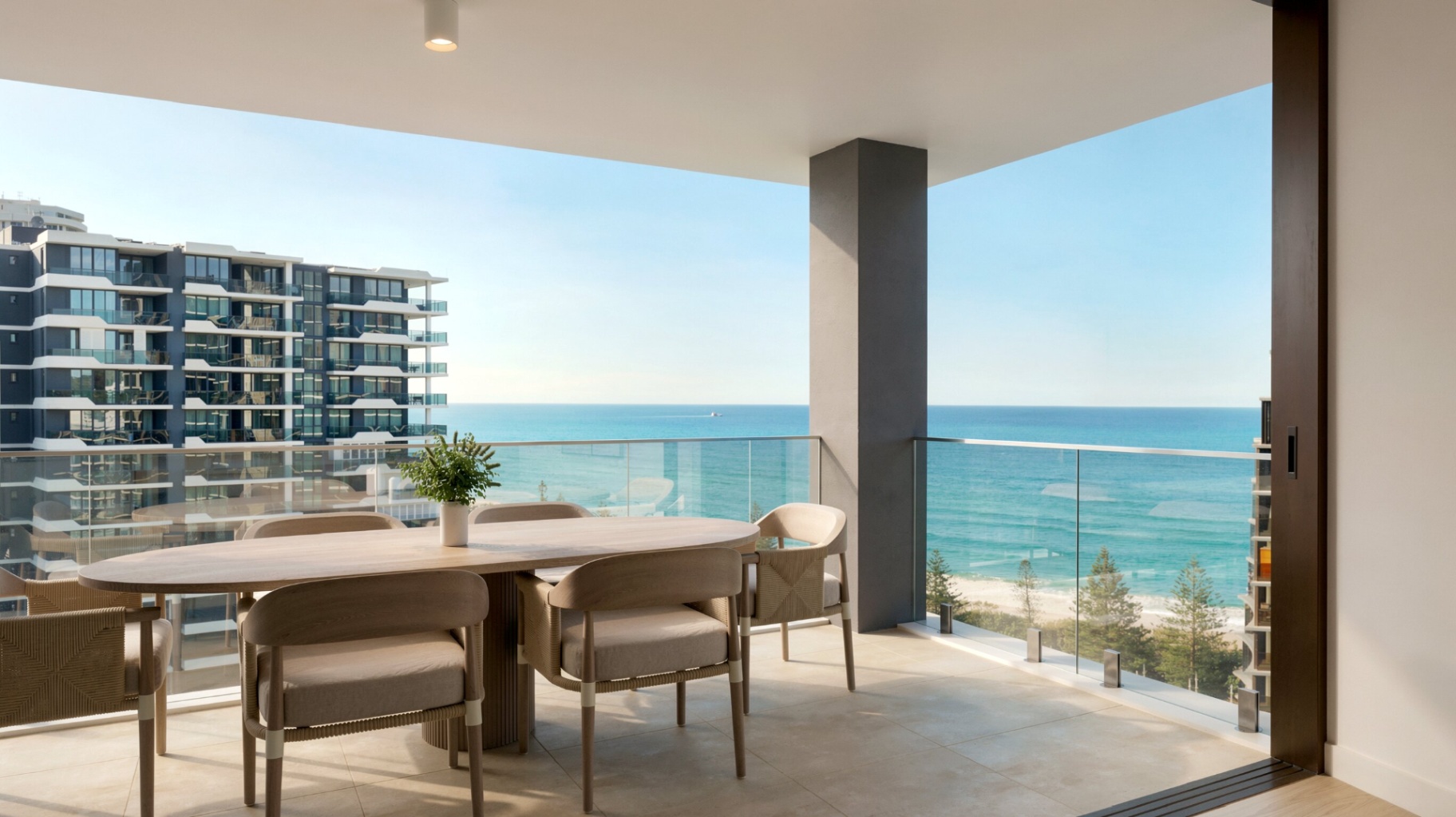 Coposit | Buy with $10K | Gold Coast Real Estate Market | Buy Property in QLD
Lura by TANCA | Burleigh Heads QLD | $10K deposit | Secure with $10k and $1,390 x 50 weeks
For a buyer targeting a $500,000 property with a 10% deposit, the goal is $50,000 in cash savings plus the transaction costs that come on top. How much cash do you actually need before signing a property contract lays out what that full cash requirement actually looks like when stamp duty, legal fees, and lender costs are included.
At $400 extra per week in savings capacity from staying home rather than renting, a buyer can reach a $50,000 deposit savings goal in roughly two and a half years. The same buyer paying market rent in Sydney might take five to seven years to reach the same position, assuming property prices hold still long enough for savings to catch up, which they historically have not.
Can you buy off the plan with less cash today but more savings later is directly relevant for buyers who are in the process of saving but want to understand whether they can commit to a property before the full lump sum is assembled.
The benefit of the period living at home accumulates not just in cash saved but in the financial habits built during it. Buyers who have lived below their means for two or three years, directed a fixed weekly amount to savings consistently, and understood what their real cost of living is are significantly better prepared for the financial discipline of mortgage repayments than buyers who have been spending at the limit of their income throughout their twenties.
For buyers who have saved enough to get started but not enough for a full traditional deposit, Coposit offers a path that does not require staying at home until the entire lump sum is assembled. Eligible off-the-plan properties can be secured with $10,000 upfront, with the remaining deposit paid in weekly instalments during the construction period. A buyer can commit to a property earlier and use the construction timeline to continue building the remaining funds rather than waiting years longer for a single lump sum.
For buyers who have saved enough to get started but not enough for a full traditional deposit, Coposit offers a path that does not require staying at home until the entire lump sum is assembled. Eligible off-the-plan properties can be secured with $10,000 upfront, with the remaining deposit paid in weekly instalments during the construction period. A buyer can commit to a property earlier and use the construction timeline to continue building the remaining funds rather than waiting years longer for a single lump sum.
For young Australians who want to move out of the family home while still working toward ownership, Unrent by Coposit offers a different model entirely. Participants live in the home they intend to buy under a licence agreement, with their weekly payments building toward purchase. It is a direct alternative to renting indefinitely while saving, allowing someone to live independently in their own place from day one rather than extending the time in the family home waiting for the deposit to accumulate.
Browse current eligible developments on the Coposit projects page, download the Coposit app, or contact the Coposit team to understand what is available and how the deposit timeline works.
Share this article



Follow Coposit:


© 2025 Copyright Coposit.

